
Q: In January 2025, you wrote an article in HPN about wet loads and the potential causes for them. Do you have more information on how to address wet packs specifically?
A:
You know I love a good callback!
In that article (HPN, January 2025)1, we were discussing “wet loads” and the routine cause for them. Much of the same information will apply here.
For example, are you documenting the configuration and taking pictures of the sterilization rack and contents? This can be helpful in identifying a root cause. Load configuration can be one of the causes of wet loads if rigid containers are placed over wrapped items/linen packs or if containers/trays are placed too closely together. Items should be evenly spaced (I make sure that I “slice” between the trays with the edge of my hand, like a karate chop), with rigid containers and heavier trays on the bottom rack, while lighter wraps and peel pouches should be on the top. I would recommend taking a picture of the sterilization rack and examining the configuration to see if anything jumps out visually.
Overpacked Tray: It could be an overpacked tray with dense metal mass or potentially some heavy sets weighing over 25 pounds. What were the contents of the load? All sterilizers have a weight limit for cycles, so it could be possible that you’re overloading the sterilizer itself. All questions that can be investigated with proper wet load documentation.
Wet/Dry Steam Ratio: Of course, the primary point of the January 2025 article1 was to consider the wet/dry steam ratio. Steam should be 97–98% dry saturated steam and 2–3% water. At one of my previous facilities where I was dealing with wet loads, testing revealed that we had 92–93% saturated steam and 7–8% water. This was the cause of our wet loads, and it was solved with some new steam traps installed on the boiler intake line.
Autoclave Chamber Drain: It could be a blocked or clogged autoclave drain, which would conceivably slow down the vacuum process in pre-vacuum sterilizers. Make sure to check and clean your chamber drain as recommended by the manufacturer.
Loading Overly Wet Items: You may also want to see if items are being loaded into the sterilizer wet. Too much water in the chamber before sterilization can throw off the optimum wet/dry steam ratio (97–98% dry to 2–3% wet), so make sure you are drying items before packaging them for the autoclave. Yes, we know not to load the low-temp sterilizers with any moisture, but it’s important to think about that drying step with the steam sterilizer as well.
Specific Product Consideration: Say you’ve gone through all the troubleshooting steps and you’re still having issues with sporadic wet trays in your loads. You may need to consider specific products designed for drying. For example, you might have a loaner tray with dense metal mass and multiple layers. This hypothetical tray will cause more of an issue with drying than its standard counterparts simply because of its construction.
Moisture Wicking: This is a good point to talk about the concept of moisture wicking. Here’s the way it’s been explained to me. Moisture accumulation will occur during the steam sterilization process because about 2–3% of the steam content will be water. To assist with the drying process, it’s helpful to have moisture-wicking materials (e.g. towels or liners) under the trays. The moisture can accumulate on these materials instead of the tray, spread out over the full surface area of the material, and then be dried easier than if the moisture was sitting on plastic, polymer, aluminum, or another tray/container surface.
Towels and Lint: In the olden days of my youth in sterile processing, we used towels to assist with moisture wicking. This was problematic for multiple reasons, but mostly for the complications that can arise from lint. In another article, callback from May 2025 (HPN, May 2025)2, I discussed the incredible research from Dr. Wava Truscott:
“In an article by Dr. Truscott in Biomedical Instrumentation and Technology called “Lint Fiber–Associated Medical Complications Following Invasive Procedures”3, she writes, “The most prevalent complications associated with lint contamination of surgical wounds include thrombogenesis (blood clot formation), infections (increased frequency, severity, biofilm formation), amplified inflammation, poor quality wound healing, granulomas, and adhesions.”
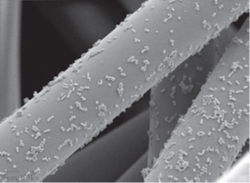
Suffice to say, lint inside surgical trays is very bad, and we should avoid laundered reusable towels inside our trays if it’s at all possible.
Disposable Liners: So, what is left if we get rid of our reusable towels? I recommend disposable liners (e.g. Underguard Dry™ Advanced5) that can accomplish the same result as towel wicking, arguably even more effectively.
Dual-layer Liners: For those dense, multi-layer trays (like the hypothetical loaner tray mentioned earlier), I would recommend liners with dual-layer construction specifically designed for these types of difficult-to-dry sets.
Specialized Wrap: There are also special wraps on the market designed to deal with wet pack issues. Instead of being dual-bonded SMS layers, one layer of Healthmark’s SafeGuard Dry Sterilization Wrap is “wetlaid.”
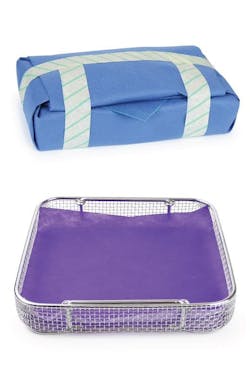
Wetlaid material is a type of nonwoven fabric produced using a process similar to papermaking, where short fibers are suspended in water and then dried on a moving wire to form a uniform web, which is then bonded together to create a final product. This wetlaid process allows for the formation of highly precise, uniform, and porous materials from a variety of fibers, including natural, synthetic, and even glass fibers. Wetlaid materials are used in many applications, such as filters, teabags, and structural components, as well as medical materials like sterilization wrap.
Because of the unique properties of the wetlaid layer, SafeGuard Dry Sterilization Wrap6 can be a great option for facilities dealing with dense, heavy, or multi-level trays and complicated wet pack situations.
References:
-
Okada, A. (2024, Dec. 24). Wet Loads. Healthcare Purchasing News (HPN). https://www.hpnonline.com/sterile-processing/article/55246796/wet-loads
-
Okada, A. (2025, April 25). Lint-free or Non-Linting? Healthcare Purchasing News (HPN). https://www.hpnonline.com/sterile-processing/article/55285901/lint-free-or-non-linting
-
Truscott, W. (2023). Lint Fiber-Associated Medical Complications Following Invasive Procedures. Biomedical instrumentation & technology, 57(s1), 5–10. https://doi.org/10.2345/0899-8205-57.s1.5
-
Truscott, W. (2014). The Clinical Issue: Foreign Debris In Post-Surgical Complications [Photograph: Lint fiber with bacteria on p 2], Knowledge Network Kimberly-Clark Healthcare Education, Issue 8, 1–8.
-
Healthmark. (n.d.). Underguard Dry™ Advanced. Healthmark, A Getinge company. https://www.hmark.com/product/underguard-dry-advanced/
-
Healthmark. (n.d.). SafeGuard Dry Sterilization Wrap. Healthmark, A Getinge company. https://www.hmark.com/product/safeguard-dry-sterilization-wrap/
About the Author
 Adam Okada
Adam Okada
Clinical Education Specialist, Healthmark, a Getinge company
Adam Okada has 18+ years of experience in Sterile Processing and is passionate about helping improve the quality of patient care by giving SPD professionals and their partners greater access to education and information. He has worked in just about every position in the Sterile Processing Department, including Case Cart Builder, SPD Tech I, II, and III, Lead Tech, Tracking System Analyst, Supervisor of both SPD and HLD, Manager, and now as an Educator. Adam is the owner of Sterile Education, the world’s first mobile application dedicated to sterile processing education, and a former Clinical Manager at Beyond Clean. He has published articles for HSPA’s Process magazine, is a co-chair on AAMI WG45 as well as co-project manager for the KiiP “Last 100 Yards” group, and is the former President for the Central California Chapter of HSPA. Adam is currently a Clinical Education Specialist at Healthmark, A Getinge company, where he works on Healthmark webinars, hybrid events, and educational videos, as well as the "Ask the Educator" Podcast with Kevin Anderson.