Q: “I am a new facility IP, and I am unfamiliar with the needs of the endoscopy area. What equipment do you recommend that they need/should have?”
A:
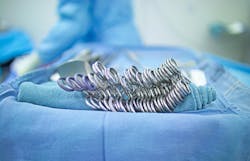
At an educational seminar in September 2025, I had the pleasure of watching the great Michael Matthews1 give a presentation on cleaning in the decontamination area. In his presentation, he gave a wonderful example of why we need the right tools to do the required tasks in sterile processing (SP) and endoscopy. A painter needs a variety of tools to do different painting projects. For example, painting a wall requires very different tools than painting a portrait. A carpenter may need dozens of tools for a woodworking project: hammer, saw, chisel, drill, sander, etc.
Reprocessing medical devices is complex and requires very specialized tools and equipment. Having only one size brush available at the SP sink for flexible scopes can be challenging if there are multiple models of endoscopes in use. Consider how each scope model's instructions for use (IFU) recommend a specific size brush.
Returning to your question, let’s take a look at the most essential specialized tools that you might need to reprocess flexible endoscopes properly.
Transport
After point-of-use treatment is performed at the point-of-use, the scope will need to make its way to the decontamination and reprocessing area. When transporting contaminated flexible scopes from the patient room, you’ll need to make sure you have a transport container that is Occupational Safety and Health Administration (OSHA) compliant.2 This means your container should be puncture-resistant, leak-proof, and large enough to hold your endoscope without having to tightly coil it (which can damage the delicate components inside).
There are several container options on the market. Do some research and find an option that best fits your facilities’ specific needs. And no, buying bins at your local department store does not make you a smart shopper. Where are the IFUs for those bins? Are they leak-proof? Surveyors will ask those questions when they see those $5 bins.
Transporting this expensive and delicate piece of equipment is an often-overlooked step, and one that could cost your facility dearly if it’s not performed properly.
Leak Tester (and possibly a leak tester TESTER)
Once the scope has safely made its way to our decontamination area, the first step in the cleaning process is to make sure the scope is safe to submerge in water/solutions by performing a leak test. There are several internal and external seals on a flexible endoscope to ensure that fluid cannot invade the electronic internal components of the scope. If fluid invasion occurs, the result will be a very expensive repair, if not a complete replacement. This step is critical to perform so that subsequent steps can be successful.
A dry leak test is performed first, followed by a wet (submerged) leak test. Always make sure to refer to your scope’s specific IFU.
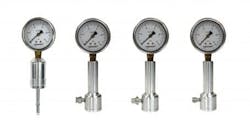
Did you know that your leak tester will need to be tested? Most automated leak testers have a specific pound per square inch (psi) requirement; so, how do you know if yours is meeting this requirement? Some newer leak testers have a self-testing function, but all of the older machines, such as a very common leak tester from a scope manufacturer that holds 90% of the market, do not. There are leak tester testers (Fig. 1) that can test your leak tester to ensure that the tester is testing as it should be.
There will be a test later. Don’t get testy about it.
Brushes
If cleaning is the most important step in the process, then brushing becomes the single most important component in the entire process. If it’s not clean, it can’t be sterile, and it’s essential that you have the right tools for this vital step. Classical Kovachian proverb says, “Keep it clean.”4
Previously mentioned, you shouldn’t just have one brush at the sink. Some flexible scopes have two lumen ports requiring two different size brushes. Some have a special brush required just for the larger entry port, and then a long lumen brush for the internal channel. Do you have a brush or sponge for the external surfaces of your scope? You should! Your manufacturer’s IFU will give you the sizes needed, so you’ll always need to have those brushes on hand.
Pro tip: Do not use enzymatic sponges at the sink with a different brand and dilution of enzymatic solution inside. The manufacturers have never tested the mixture on each product. We don't know if it will work, if the enzymes will react, or if they will inactivate one or both solutions. Instead, use a non-solution-soaked sponge, which is both effective and less costly. You’re welcome.
Automated Endoscope Reprocessor (AER)
When ANSI/AAMI ST91:20215 for endoscope reprocessing came out in early 2022, it contained the strongest recommendation possible for moving away from manual disinfection soaking and strongly recommended the use of the automated endoscope reprocessor (AER). Manual soaking was such a highly variable process that a more automated, repeatable one in the AER became a preferred option. However, errors can still occur with the AER, so this process will need to be monitored. I would pay special attention to the water inlet line into your AER. Outbreaks have occurred from contaminated water lines, so review ANSI/AAMI ST108:20236 on water quality for more information about testing here.
If your facility does not have an AER, and is still soaking scopes manually, I will align with ST91 and give my strongest recommendation possible for sunsetting this practice and acquiring an AER for your facility.
Drying
Another important takeaway from ST91 was the concept of 10 minutes of forced-air drying for scopes. Based on a 2018 water study performed by Ofstead and Associates7, residual water left in the channels of endoscopes was proven to foster microbial growth and provided a breeding ground for biofilm.
The rationale here is simple: microorganisms love dark, damp places, and endoscope channels provide a narrow, dark, damp chamber ideal for microbial growth.
In the past, we assumed that vertical hanging was sufficient. Gravity was supposed to do the drying job for us; however, because of the narrow channels and slight bends to flexible endoscopes, water droplets were shown to be present in vertically hung scopes for up to two weeks later.
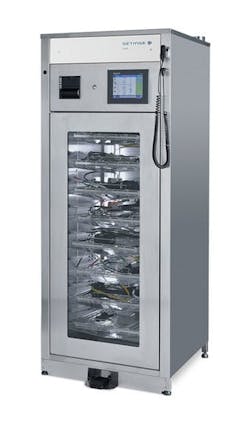
Modern endoscopy departments may have continuous forced-air drying cabinets (Fig. 2) that utilize high-efficiency particulate air (HEPA) filtered air pushed through the scope(s). The turbulent airflow forces water from the channels and creates a hostile environment for microbes. I would certainly recommend these cabinets.
Labeling
In August 2025, I wrote an article here in HPN titled “Visual Communication”9 about the importance of communication using images, graphics, or signage to convey clear visual indications between users who may never have an opportunity to see each other or speak directly. Nowhere is the need for clear interpretation of messaging more important than in the endoscopy area!
Reprocessing technicians need to be able to clearly label scopes as having been processed. I can imagine few things more problematic in the endo suite than a contaminated scope being used on multiple patients due to improper labeling.
There are many options for labeling, and they will be dependent on the unique processes present at your facility. Blank tags can do the job, but you probably want to look at options that are less open to human error.
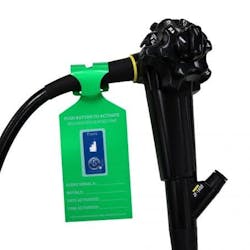
As far as clear visual indicators go, it’s tough to beat the convenience of a push-button tag (Fig. 3) that clearly indicates when your facility policy hangtime has expired, and the scope is due for reprocessing.
Conclusion
There are certainly more tools (e.g., chemistries, dosing machines, ergonomic sinks, etc.) that we can use in the endoscopy suite, but these are some of the major focus areas for surveyors that you may want to start with for compliance purposes. Flexible endoscopes aren’t getting less complex as technology advances, so it’s vital that we ensure our departments are reprocessing these devices safely and responsibly. To achieve this, we’ll need the proper tools and equipment to do the job.
References:
-
Matthews, M. (2025, September 27). Cleaning in the decontamination area. PWSPA Conference - Valley Presbyterian Hospital, Los Angeles, CA, United States of America.
-
Occupational Safety and Health Administration. Code of Federal Regulations: Occupational Exposure to Bloodborne Pathogens. Title 29 [Bloodborne pathogens], Standard No. 1910.1030(d)(2)(viii). United States Dept of Labor/OSHA. https://www.osha.gov/laws-regs/regulations/standardnumber/1910/1910.1030
-
Healthmark, A Getinge company. (2020, August). Instrument Care - Healthmark Leak Tester Tester. https://www.hmark.com/product/leak-tester-tester/
-
Kovach, Stephen M. (n.d.). “Keep it clean.” [Quote].
-
AAMI (2021). ANSI/AAMI ST91:2021 Flexible and semi-rigid endoscope processing in health care facilities. Arlington, VA: Association for the Advancement of Medical Instrumentation.
-
AAMI (2023). ANSI/AAMI ST108:2023 Water for the processing of medical devices. Arlington, VA: Association for the Advancement of Medical Instrumentation.
-
Ofstead, C. L., Heymann, O. L., Quick, M. R., Eiland, J. E., & Wetzler, H. P. (2018). Residual moisture and waterborne pathogens inside flexible endoscopes: Evidence from a multisite study of endoscope drying effectiveness. American Journal of Infection Control, 46(6), 689–696. https://doi.org/10.1016/j.ajic.2018.03.002
-
Getinge. (2025). EDS8 Drying and Storage Cabinet for endoscopes. https://www.getinge.com/int/products/getinge-eds8-drying-and-storage-cabinet/
-
Okada, A. (2025, August 26). Visual Communication. Healthcare Purchasing News (HPN) Online. https://www.hpnonline.com/sterile-processing/article/55306340/visual-communication
-
Healthmark, A Getinge company. (2020, August). Labeling and Signage – 7-Day Indicator Hangtime Label. https://www.hmark.com/product/7-day-indicator-hangtime-label/
About the Author
 Adam Okada
Adam Okada
Clinical Education Specialist, Healthmark, a Getinge company
Adam Okada has 18+ years of experience in Sterile Processing and is passionate about helping improve the quality of patient care by giving SPD professionals and their partners greater access to education and information. He has worked in just about every position in the Sterile Processing Department, including Case Cart Builder, SPD Tech I, II, and III, Lead Tech, Tracking System Analyst, Supervisor of both SPD and HLD, Manager, and now as an Educator. Adam is the owner of Sterile Education, the world’s first mobile application dedicated to sterile processing education, and a former Clinical Manager at Beyond Clean. He has published articles for HSPA’s Process magazine, is a co-chair on AAMI WG45 as well as co-project manager for the KiiP “Last 100 Yards” group, and is the former President for the Central California Chapter of HSPA. Adam is currently a Clinical Education Specialist at Healthmark, A Getinge company, where he works on Healthmark webinars, hybrid events, and educational videos, as well as the "Ask the Educator" Podcast with Kevin Anderson.