Key Highlights
- Using only one or two brush sizes can lead to ineffective cleaning due to mismatched lumen diameters and device complexities.
- Different devices, like Frazier suctions and arthroscopic shavers, require multiple specialized brushes for thorough decontamination.
- Consult manufacturer instructions for use (IFU) or utilize lumen sizers to identify the correct brush sizes for each device.
- Disposable pull-through brushes can prevent damage caused by traditional brushing methods and streamline the cleaning process.
- Proper tool selection and understanding device-specific cleaning needs are vital for ensuring safety and optimal device performance.

Q: “I am a traveler and just arrived at a hospital with only toothbrushes and two sizes of channel brushes. Help!”
A:
I’m willing to overlook the fact that this isn’t a question because clearly you are in dire need of help!
If you were on a construction site, would you be able to accomplish every task you need to do with only a saw or a hammer?
What if Vincent van Gogh only had the color red at his disposal?
Jokes aside, I’ve been to a surprising number of hospitals all over the United States that are in a similar situation. We need the right tools to do our jobs—just as we would on a construction site or if we were one of the world’s most famous artists—and our job is incredibly important!
First, let’s examine some of the problems that can arise from having only three types of brushes.
Problem #1: One Brush Size Does Not Fit All Lumened Devices.
Unless you specifically intend to build your facility’s instrument inventory around the cost savings of having just two sizes of brushes [spoiler: it’s not a cost savings], then you’re probably missing instruments with lumens too large or small for your meager brush inventory.
With brushes, think of them like Goldilocks and the Three Bears.1
- If the brush is too small, it will bounce around the lumen, hitting parts of the inner channel but not actually cleaning the full internal diameter.
- If the brush is too large, the bristles will bend backwards, creating a rubbing action on the inner channel but not scraping debris away in the way the brush was intended to.
For this paragraph (and this paragraph only), compare our decontamination “block-style” brush with that of our standard bathroom toothbrush. (NOTE: They are NOT the same and NOT interchangeable for decontamination purposes, but more on that later.)
When you get a brand-new toothbrush out of the package at home, the bristles are standing straight up and thus provide a scraping action against your teeth. Once that toothbrush becomes worn over time, the bristles bend backward and out and no longer provide the same cleaning action they once did because the tips of the bristles are no longer able to scrape your teeth the way they did when they were new.
It’s worth repeating: Do not substitute a store-bought toothbrush from home for a medical-grade decontamination block-style brush. Though similar in appearance, their construction, functionality, and intended usage are very different.
That being said, when channel brushes are too large for the lumen they are cleaning, the bristles bend backward and the tips are no longer able to clean effectively.
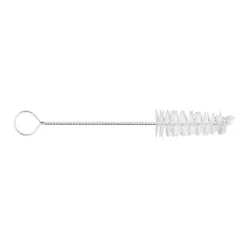
Back to our Goldilocks analogy. You need a channel brush that is exactly the right width for the lumen you are cleaning. If you are using different-sized Frazier suctions at your facility, you’ll need channel brushes that can accommodate all those different sizes. Yankauers? More brushes. Poole suctions? Yep, more brushes! You’ll need different-sized brushes (Fig. 1) for every lumen size you have.

Problem #2: Lumens Can Vary in Width From End to End.
While explaining that you need to have various-sized brushes to accommodate various-sized lumens is a relatively easy concept to understand, there are more complications. For example, Frazier suctions have multiple openings, and each opening is likely to require a different-sized brush. The distal end of the Frazier, and most of the suction itself, will have a uniform diameter (7 fr, for example). But the end that attaches to the suction machine will likely be larger and thus require a larger brush for that end. There is also the issue of the “thumb-hole,” which refers to that strange hole in the middle/flat surface of the suction. This hole is plugged during the procedure, and it can allow blood or other body fluids in that small opening. Therefore, you should have another size brush that can clean out the thumb-hole.
On a Yankauer suction, you’ll need a channel brush to clean the inside. Pay special attention to older or cheaper models that may have a hollow middle. Other types of brushes are necessary for cleaning the tip and the inside of the tip.
Poole suctions come apart, and you’ll need a few different-sized brushes to clean them, including a “fan-tip” brush to clean the rounded end.
I could keep listing examples of devices that have multiple-sized lumen openings, but I think you get the point.
Problem #3: Some Complex Devices Require Specialized Brushes.
If realizing that you may need three brushes to clean a Frazier suction wasn’t bad enough, consider the problem of trying to clean an arthroscopic shaver. Shavers have been discussed at almost every educational conference I have attended over the last few years; the problem still doesn’t show signs of going away anytime soon.
Arthroscopic Shaver Cleaning Area Complications
These shaver devices have multiple areas inside that are either hidden from view or have a very difficult-to-reach area with our standard brushes to properly clean.
1. Drive-Fork Area:
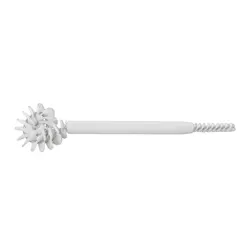
The drive fork (the internal motor’s mechanical coupling) is located at the bottom of the large lumen opening where the disposable shaver blade attaches. Due to its recessed location, it can be extremely difficult to clean. Consider that you have two styles of brushes at your disposal: the typical block-style (or “toothbrush-style”) and channel brushes. Both have bristles that stick out horizontally when going down the large lumened area of the shaver (Fig. 2), but neither of them will be able to clean the flat area at the bottom. Some shavers also have drive-fork prongs that stick up from the flat bottom, making it almost impossible to clean underneath that raised mechanism.
2. Luer-lock:
The luer-lock (or “switch”) is usually located on the suction lumen. This “switch” opens and closes via a luer-lock mechanism. When brushing this area, we often clean it with the “switch” in the open position (you know, so that we can get the brush through), but we almost never clean it with the “switch” closed. As a result, debris that may be on the luer-lock area can easily be missed.
(NOTE: Some models of shavers have a removable “switch” to help us clean it!)
Because of these complicated areas on the shaver (and because of the numerous sized openings), we may need up to five brushes/sponges to properly clean an arthroscopic shaver. That’s two more brushes than our traveler had access to at their new facility!
Other complex devices of note that may require multiple and/or specialty brushes:
- Flexible endoscopes
- Acetabular reamers (Fig. 3)
- Flexible reamers (Fig. 4)
- Rasps

Solutions:
Choosing the Right Brush for Each Device
But let’s not focus too much on the problems we are having with identifying so many brushes that we need. There are some products on the market that can help.
If you aren’t sure what size brush you need to clean a specific device, check the device manufacturer’s instructions for use (IFU). Sometimes these IFUs can identify specific sizes and lengths for the brushes you need.
If the IFU doesn’t list the specific sizes, there are products on the market called “lumen sizers” (Fig. 5) that can help you identify the brushes you need. Simply place the lumen on the sizer until it fits perfectly over one of the raised areas.

Are Disposable Brushes Right for You?
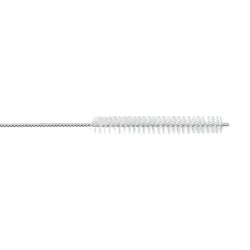
It’s also worth noting that disposable brushes can be an option for your facility, especially if you are having issues with worn brushes that keep finding their way back into usage at the sink. I’m personally a big fan of “pull-through” brushes. Pushing a standard channel brush through from the bottom of the lumen through to the tip can potentially bend the channel brush as it meets resistance on its pathway through the lumen. This is how we end up with bent, coiled, and “snaking” damage to brushes. But “pull-through" channel brushes (Fig. 6) eliminate that issue by inserting the narrow, non-bristled end of the brush first and pulling the brush through.
In conclusion, I hope that helps you out! Feel free to show this article to your department supervisors and ordering managers so that they can give you the tools you need to do the job!
References:
1 . Steel, F. A., John Shaw Billings Memorial Fund, & Anna Palmer Draper. (1922). ENGLISH FAIRY TALES [Book]. THE MACMILLAN COMPANY. https://ia800703.us.archive.org/23/items/englishfairytales00stee/englishfairytales00stee.pdf. Goldilocks and the Three Bears was originally titled The Story of the Three Bears. Page 19 of English Fairytales (Page 37 of U.S. Archive.org PDF).
2. Healthmark Industries. (2024a, June 2). Various-sized Instrument Tube Brushes (ITB) - Healthmark, A Getinge company. Healthmark, a Getinge Company. https://www.hmark.com/product/instrument-tube-brushes/
3. Healthmark Industries. (2024a, June 2). Arthroscopic Shaver Brush - Healthmark, A Getinge company. Healthmark, a Getinge Company. https://www.hmark.com/product/shaver-cleaning-brushes/
4a. Healthmark Industries. (2024a, June 2). Acetabular Reamer Brush - Healthmark, A Getinge company. Healthmark, a Getinge Company. https://www.hmark.com/product/acetabular-reamer-brushes/
4b. Healthmark Industries. (2024a, June 2). Reamer Channel Brushes - Healthmark, A Getinge company. Healthmark, a Getinge Company. https://www.hmark.com/product/reamer-channel-brushes/
5. Healthmark Industries. (2024a, June 2). Lumen Sizer - Healthmark, A Getinge company. Healthmark, a Getinge Company. https://www.hmark.com/product/lumen-sizer/
6. Healthmark Industries. (2024a, June 2). Instrument Channel Brush - Healthmark, A Getinge company. Healthmark, a Getinge Company. https://www.hmark.com/product/tube-brushes-for-cleaning-lumens/
About the Author
 Adam Okada
Adam Okada
Clinical Education Specialist, Healthmark, a Getinge company
Adam Okada has 18+ years of experience in Sterile Processing and is passionate about helping improve the quality of patient care by giving SPD professionals and their partners greater access to education and information. He has worked in just about every position in the Sterile Processing Department, including Case Cart Builder, SPD Tech I, II, and III, Lead Tech, Tracking System Analyst, Supervisor of both SPD and HLD, Manager, and now as an Educator. Adam is the owner of Sterile Education, the world’s first mobile application dedicated to sterile processing education, and a former Clinical Manager at Beyond Clean. He has published articles for HSPA’s Process magazine, is a co-chair on AAMI WG45 as well as co-project manager for the KiiP “Last 100 Yards” group, and is the former President for the Central California Chapter of HSPA. Adam is currently a Clinical Education Specialist at Healthmark, A Getinge company, where he works on Healthmark webinars, hybrid events, and educational videos, as well as the "Ask the Educator" Podcast with Kevin Anderson.