More Influence. A Stronger Voice?
Key Highlights
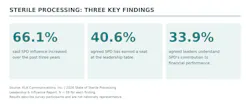
- 66.1% of respondents reported increased influence of sterile processing over the past three years, yet only 40.6% felt SPD had a seat at the leadership table.
- Strongest collaborations exist with the operating room (91.4%), while executive leadership engagement remains limited at 25.9%.
- Staffing shortages and budget limitations are primary challenges, often hidden by overtime and workarounds, which can obscure true departmental pressures.
- Involvement in purchasing decisions varies, with many SPD departments brought in late or not at all, highlighting opportunities for earlier engagement to improve outcomes.
- Most respondents believe leadership understands SPD’s clinical and operational roles better than its financial contributions, indicating a need for better data sharing and financial visibility.

Research: KLN Communications, Inc. | Commentary: HPN
Sterile processing professionals know how closely their work connects to surgical care. Every instrument inspected, tray assembled, and cycle monitored supports the organization’s ability to deliver that care safely and efficiently. Whether that responsibility translates into organizational influence is a different question.
The 2026 State of Sterile Processing Leadership & Influence Report, conducted and published by KLN Communications, explores that distinction. Its findings describe a profession making progress while continuing to seek earlier involvement in purchasing, greater executive access and stronger recognition of its financial contribution.
Among respondents, 66.1% said sterile processing’s influence within their organizations had increased over the previous three years. Yet only 40.6% agreed that SPD had earned a seat at the leadership table. Another 25.4% were neutral, and 33.9% disagreed.
Those results invite hospitals to look beyond whether sterile processing receives recognition. The more useful questions concern participation. Which decisions involve SPD? When does that involvement begin? And can the department’s input meaningfully change a plan?
Recognition and participation
SPD leaders can have productive relationships with clinical departments while remaining removed from broader organizational planning.
Survey respondents reported particularly strong connections with the operating room: 91.4% said their sterile processing function collaborates with the OR at least monthly. Infection prevention followed at 65.5%, while 53.4% reported monthly collaboration with supply chain.
Executive leadership was further down the list, at 25.9%.
These findings do not establish how effective those relationships are or how frequently collaboration should occur. They do, however, raise a question about how information travels. If an SPD leader identifies a capacity constraint, recurring equipment problem, or growing training need, does that concern reach someone with the authority to address it?
An invitation to a meeting is one step. A process for evaluating recommendations, assigning responsibility, and following through makes participation more useful.
Bring SPD in before the purchase
Purchasing provides a concrete opportunity to examine that process.
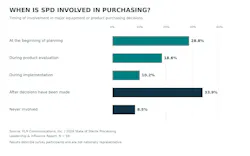
In the survey, 28.8% of respondents said SPD becomes involved in major equipment or product purchasing decisions at the beginning of planning. Another 18.6% reported involvement during product evaluation, and 10.2% during implementation.
Meanwhile, 33.9% said SPD is brought in after decisions have already been made, and 8.5% said it is never involved.
Combined, 42.4% reported involvement only after decisions, or no involvement at all.
The survey does not establish that late involvement causes higher costs, delays, or safety problems. Its findings nevertheless give purchasing and perioperative teams a reason to review when reprocessing expertise enters their decision-making process.
A proposed device or new surgical service may raise questions about processing instructions, equipment compatibility, instrument inventory, staffing, and capacity. Those questions are easier to incorporate into an evaluation while options remain open.
Make the financial connection visible
Respondents generally believed organizational leaders understand sterile processing’s clinical and operational contributions better than its financial contribution.
About seven in 10 agreed that leadership understands SPD’s role in OR efficiency and infection prevention/surgical quality. Only 33.9% agreed that leadership understands its contribution to financial performance, while 45.8% disagreed.
That finding points to an opportunity for a more specific conversation about resources.
Requests for staffing, equipment, or additional instruments can explain the operational problem, the services affected and the expected benefit of addressing it. Useful measures might include instrument availability, tray defects, repair expenses, turnaround time, and OR delays, paired with the organization’s own cost information.
Respondents placed considerable importance on operational metrics. Confidence in using that information was more mixed: 50.8% said they were very or extremely confident using operational data to support decisions or justify SPD investments.
Hospitals can help by connecting SPD with finance, quality, and supply chain colleagues who can support data analysis and investment proposals. The goal is a shared understanding of what the department needs and how those resources support organizational priorities.
Keeping work moving can hide the strain
The report’s open-ended responses add another dimension. A department can continue meeting daily demands while struggling with the conditions under which that work gets done.
Respondents described overtime, workarounds, and constant prioritization that can make staffing, equipment, and workflow pressures less visible outside SPD.
Compensation and staffing shortages were the most frequently selected current challenges, cited by 57.6% and 55.9% of respondents, respectively. Budget limitations, burnout, and leadership development followed.
For hospital leaders, those findings support looking beyond whether today’s surgical schedule was completed. What did completing it require? Were staff repeatedly working additional hours? Did equipment problems force changes in workflow? Are temporary solutions becoming routine?
Those conversations can give leaders a fuller picture of departmental performance and resource needs before a visible disruption demands their attention.
Before the next purchase
Purchasing, perioperative, and SPD leaders can start with four shared questions:
-
Capacity: Can SPD support the added volume and turnaround expectations?
-
Compatibility: Do existing systems support the manufacturer’s reprocessing instructions?
-
People: What training, competency assessment, and staffing will be needed?
-
Resources: What instruments, space, utilities, and ongoing expenses belong in the evaluation?
The answers can help connect purchasing decisions with the work required to support them.
About the research
KLN Communications conducted the independent survey in summer 2026, receiving 60 submissions, with 59 substantive responses on most questions. Percentages use the number answering each question.
Participants skewed toward experienced professionals and department leaders. Findings reflect respondents’ perceptions and self-reported experiences and should not be interpreted as nationally representative. The study was not sponsored, funded, or influenced by a healthcare provider or industry supplier.
Despite the pressures described, 69.5% of respondents were somewhat or very optimistic about the profession’s future. That optimism offers a constructive starting point for conversations about stronger participation and organizational support.
Explore the full report: Visit HPN’s website for additional findings, respondent perspectives and methodology from the 2026 State of Sterile Processing Leadership & Influence Report.
About the Author
 Daniel Beaird
Head of Content and Editor-in-Chief
Daniel Beaird is Head of Content and Editor-in-Chief for Healthcare Purchasing News.