Preparing the Next Generation of Sterile Processing Professionals
Key Highlights
- Santa Fe College's program combines technical coursework, laboratory exercises, and clinical internships to build foundational knowledge and practical skills in sterile processing.
- Certification is viewed as a milestone, but the program emphasizes understanding the 'why' behind each step to foster critical thinking and problem-solving abilities.
- Partnerships with hospitals like UF Health Shands enable real-world training, feedback, and curriculum adjustments to meet workplace needs.
- Students are taught to locate reliable information, interpret sterilizer printouts, and recognize when to seek guidance, promoting professional judgment and safety.
- Expanding clinical capacity and supporting working students through flexible scheduling and scholarships are key to growing the program and strengthening the workforce.

Early in her career, Julia Wagner worked in a facility where sterile processing training depended heavily on knowledge passed down by experienced staff. Employees knew how their colleagues performed tasks, but they did not always understand the reasoning behind each step, how those practices aligned with established guidance, or how to troubleshoot problems.
At the time, Wagner said, none of the staff held the Certified Registered Central Service Technician credential.
“That limited foundation created potential risks because we lacked the knowledge to recognize when a different approach was needed,” she said.
Earning her CRCST certification while developing and expanding Santa Fe College’s sterile processing program helped Wagner identify gaps in her own knowledge. The experience reinforced her belief that entry-level preparation should teach students how to perform the work and why each step matters.
Today, Wagner, MS, CHES, CSFA, CRCST, serves as program director, assistant professor, and clinical coordinator for Sterile Processing Technology at Santa Fe College in Gainesville, Fla. Her approach combines scientific instruction, hands-on laboratory practice, and a clinical internship to help students build a foundation for professional practice.
It also responds to concerns she heard from local hospitals and that’s finding employees who understood the responsibility of sterile processing, demonstrated consistent attention to detail, and wanted to build a career in the field.
“Those conversations helped shape a program focused on technical knowledge, critical thinking, professionalism, and accountability,” Wagner said.
Santa Fe’s experience offers a starting point for a broader conversation about workforce development. Colleges can provide structured education, but hospitals remain essential partners in clinical learning, orientation, and continued development. Preparing future professionals requires both organizations to understand what students have learned, what they can demonstrate, and where they still need support.
Building the foundation before clinical placement
Santa Fe’s Sterile Processing Technology program spans two semesters and 30 credit hours. Admission uses a points system that considers GPA, military service, and completion of courses such as Public Speaking, Medical Terminology, and College Composition.
During the first semester, students study sterile processing using HSPA’s technical manual while taking microbiology and a hands-on laboratory course. Laboratory activities introduce instrument identification, inspection, assembly, and packaging before students enter a clinical department.
The second semester combines a clinical internship with online courses in endoscopy, surgical anatomy and physiology, and professionalism.
That sequence gives students opportunities to develop foundational knowledge, practice essential skills, and then apply both in a working department. The accompanying coursework continues while they gain clinical experience, allowing classroom subjects and workplace observations to inform one another.
For Wagner, that preparation has a purpose extending beyond an examination.
“Certification is an important milestone, but I want students to be prepared for the responsibilities of the job as well as the exam,” she said.
Students work through clinical scenarios and practice troubleshooting situations they may encounter in a department. They must learn to explain why a step matters and how to respond when circumstances differ from what they expected.
The broader goal is to help students understand the profession they are entering.
“For me, success means helping students earn their certification and build a lasting career,” Wagner said.
Connecting science to the patient
Microbiology and anatomy can seem removed from a workbench until students connect them to an instrument, a procedure, and a patient.
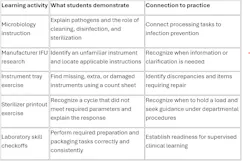
Wagner makes those connections throughout the program. In microbiology, students learn about pathogens, how infections develop, and the role of cleaning, disinfection, and sterilization in infection prevention. In surgical anatomy and physiology, they connect instruments and procedures to the tissues and structures involved.
Discussions about a potentially preventable surgical site infection help make the consequences of processing decisions tangible.
“Understanding the anatomy involved and everything required to deliver a sterile instrument makes the responsibility more tangible,” Wagner said. “Students begin to see processing as a series of decisions that protect a patient.”
That educational approach gives instructors a way to move beyond recall. Students can be asked to explain the purpose of a requirement, describe the potential consequences of a missed step, and connect an individual task to the larger processing sequence.
The objective is to build understanding that students can carry into unfamiliar situations. An employee may encounter an instrument they have never handled or equipment they have not used. A scientific foundation can provide context, while an understanding of their own limits helps them recognize when additional information or assistance is necessary.
For department leaders, that combination is an important part of evaluating preparation: what a new employee knows, how they apply it, and how they respond when they do not have an answer.
Learning how to find reliable information
Wagner does not expect students to memorize every instrument they will encounter.
Instead, she teaches them how to identify an item, locate reliable information, and determine whether they have what they need to proceed.
Assignments require students to find manufacturers’ instructions for use and identify requirements for different stages of processing, including decontamination, inspection, assembly, and sterilization.
When presented with an unfamiliar instrument, students practice locating its reference or catalog number, identifying its manufacturer, and finding the applicable instructions on the manufacturer’s website.
The exercises also introduce situations where proceeding would require clarification. Students must consider whether instructions are clear and whether the required equipment is available.
“I want them to recognize that uncertainty is a reason to ask questions,” Wagner said.
That expectation makes seeking guidance part of professional practice. The educational task is to help students recognize uncertainty early enough to respond appropriately.
“Students do not need to memorize every instrument they will encounter, but they do need to know how to find reliable information, apply it correctly, and recognize when they need help to process an item safely,” she said.
For employers, this provides a useful discussion point with educational partners. Familiarity with instruments matters, but so does the ability to investigate an unfamiliar item and communicate what remains unresolved.
Making judgment visible in the laboratory
Laboratory exercises allow Wagner to assess both a student’s actions and the reasoning behind them.
In one activity, students receive an instrument tray containing missing, extra, or damaged instruments. Using a count sheet, they must identify discrepancies, determine what should be added or removed, and recognize instruments that should be taken out of service for repair.
The exercise asks students to do more than assemble a tray. They must examine what is in front of them and decide whether it meets the requirements of the assignment.
In another activity, students interpret sterilizer printouts. They compare a cycle that met its required parameters with one that did not achieve the required temperature for the specified exposure time.
Students must identify the problem and explain the appropriate next steps, including holding the load and seeking guidance according to departmental procedures.
“I assess both their decisions and their reasoning,” Wagner said. “Recognizing an error is only part of the task; students also need to explain why it matters and how their response protects the patient.”
These exercises provide concrete examples of what critical thinking means in the curriculum. Rather than treating it as an abstract educational goal, Wagner asks students to identify a concern, explain its significance, and determine their response.
Establishing readiness for the clinical setting
Before clinical placement, students practice instrument identification, tray assembly using count sheets, inspection of rigid sterilization containers, preparation of peel pouches, and wrapping instrument trays.
Their readiness is assessed through skill checkoffs. Students must demonstrate that they can perform the required tasks correctly and consistently, complete the checkoffs, and pass the laboratory course before beginning their internship.
That requirement establishes an initial threshold for placement. Students enter with practical skills they will continue developing under supervision.
It also creates a basis for communication between the college and the clinical site. Hospital educators can build on the preparation students have received while identifying where they need additional practice.
The distinction matters because readiness for a clinical internship and readiness for independent work are different stages of development. A student can arrive prepared to participate in supervised learning while still needing substantial instruction before assuming the responsibilities of an employee.
The partnership works best when those expectations are clear to faculty, hospital staff, and students.
UF Health Shands connects education with practice
UF Health Shands is an established clinical partner of Santa Fe College. HPN’s 2025 SPD of the Year coverage described students learning sterile processing fundamentals at the college before gaining hands-on experience at UF Health Shands. Santa Fe also highlighted the collaboration in an April 2025 announcement.
That relationship connects formal instruction with the experience of a working department.
Wagner said clinical partners help identify skills that require additional practice and areas where students need stronger preparation. Their observations help her keep classroom and laboratory instruction connected to workplace expectations.
At the clinical site she described, dedicated educators supervise students and assess their progress weekly using evaluation forms she developed. Those evaluations provide a way to follow skill development, identify challenges, and determine where support is needed.
The feedback also informs curriculum decisions.
“It helps me determine which topics or activities to expand, revise, or reduce so that instruction remains relevant to clinical practice and students’ needs,” Wagner said.
This exchange makes the clinical relationship more than a placement arrangement. The college prepares students for the department, and the department provides information that helps the college improve its preparation.
A foundation employers can build on
By the end of the internship, Santa Fe students have rotated through most areas of a sterile processing department and completed nearly 200 hours of hands-on experience, Wagner said.
On their first day of employment, she expects graduates to be able to assemble an instrument tray using a count sheet with little assistance and demonstrate a strong foundation in safe processing practices.
That expectation comes with an equally important qualification. Hiring departments must still provide facility-specific orientation and verify competency.
Graduates need to learn the employer’s workflows, policies, equipment, and processing requirements. Their orientation includes the department’s particular sterilizers, ultrasonic cleaners, washer-disinfectors, and other equipment.
“They enter with meaningful knowledge and skills that they can build on as they learn the department’s expectations,” Wagner said.
This division of responsibility offers a practical framework for colleges and hospitals. The college develops foundational knowledge and skills. Clinical experience gives students an opportunity to apply them. The employer then provides the orientation and assessment required for its own environment.
For leaders considering a partnership, a useful first step is agreeing on what students should demonstrate at each stage, and how those expectations will be communicated.
Clinical capacity shapes growth
Expanding a program requires sufficient clinical capacity.
Wagner identified clinical placements as a central requirement for further growth at Santa Fe. Additional sites must have the capacity to support students, including adequate supervision and access to educators.
Many departments are understaffed, she noted, which can make that commitment difficult.
“Growth depends on having enough placements and the resources to make those placements meaningful learning experiences,” Wagner said.
The challenge is operational as well as educational. A placement needs staff attention, clear learning objectives, feedback, and opportunities for students to practice. Increasing the number of available positions requires considering whether those supports can grow alongside enrollment.
For hospital leaders, the question is how to make teaching sustainable within daily work. That includes understanding who will supervise students, how educators will communicate with faculty, and how the department will respond when a learner needs additional support.
Supporting students who need to keep working
Program design also affects who can participate.
One of the largest barriers Santa Fe students face is balancing education with full-time employment, Wagner said. Many need to continue earning an income while completing coursework and clinical requirements.
Santa Fe has structured the second semester around a clinical internship two days per week, with the accompanying coursework offered online. That reduces additional trips to campus and allows students more flexibility to complete assignments around work schedules.
“The clinical commitment still requires planning, but this structure makes the program more accessible to working students,” Wagner said.
Access is an important consideration for hospitals looking to strengthen a local workforce pathway. An educational opportunity may be valuable, but prospective students must be able to fit it into their lives.
Wagner suggested that hospitals consider scholarships for current employees to complete a formal sterile processing program. Such support could create opportunities for advancement while helping the organization develop its workforce.
The idea also invites employers to look within their own organizations for prospective students. Employees interested in a different healthcare role may benefit from a pathway that makes the educational requirements, financial support, and potential next steps clear.
Following graduates into employment
Wagner said Santa Fe tracks cohort sizes, program completion, certification results, and student retention, reviewing outcomes across the academic year from fall through summer. The program currently admits a new cohort each semester.
Formal job placement tracking is still being developed.
Although the program is not required to track placement, Wagner sees value in establishing a process to follow graduates into employment and assess longer-term retention.
“Tracking placement and longer-term employment retention would give us a clearer picture of how well the program prepares students for lasting careers in sterile processing,” she said.
That distinction is important when evaluating results. Wagner has observed graduates obtaining employment and remaining with their departments, but those experiences are not yet a substitute for systematic placement and employment-retention data.
Following graduates would help connect educational outcomes with workplace experience. It could also identify where additional support is needed in finding a position, transitioning into employment, or continuing professional development.
Sharing responsibility for the next generation
Wagner’s own experience gives her a clear view of what she wants students to gain. That’s practical skills supported by enough understanding to recognize a problem, investigate it, and seek help.
Her advice to colleges and hospitals considering a partnership begins with investing in people.
“Colleges can provide the educational foundation, while hospitals contribute clinical experience and feedback that keeps the curriculum connected to practice,” she said.
Santa Fe’s model shows how that responsibility can be shared through coursework, laboratory checkoffs, supervised clinical experience, and continuing feedback. The UF Health Shands partnership connects education to an operating department.
For sterile processing leaders, the practical questions are specific. What preparation do new employees bring? What must the department provide? Who has time to teach? How will progress be assessed? And what support will help an employee continue learning after orientation ends?
Answering those questions can help organizations build a pathway that does more than introduce people to sterile processing. It can help them develop the knowledge, judgment, and confidence to remain in the profession and grow within it.
Inside Santa Fe’s Sterile Processing Program
- Two semesters • 30 credit hours
- First semester: Sterile processing instruction, microbiology, and hands-on laboratory practice.
- Second semester: Clinical internship plus online coursework in endoscopy, surgical anatomy and physiology, and professionalism.
- Clinical experience: Two days per week during the second semester, with nearly 200 hours of hands-on experience completed by the end of the internship, according to Wagner.
- Before clinical placement: Students must complete required skill checkoffs and pass the laboratory course.
- Clinical partner: UF Health Shands
Source: Julia Wagner, Santa Fe College
About the Author
 Daniel Beaird
Head of Content and Editor-in-Chief
Daniel Beaird is Head of Content and Editor-in-Chief for Healthcare Purchasing News.
Related

 Hsap Vp