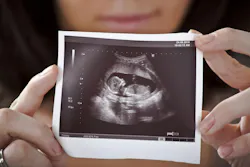
Researchers have developed a wearable ultrasound patch to monitor high-risk pregnancies. The device had its design and early validation published in Nature Biotechnology.
The patch holds promise for “helping doctors monitor conditions such as intrauterine growth restriction, which affects 10% of all pregnancies. In this pregnancy complication, the fetus grows slowly due to limited oxygen or nutrients, a result of insufficient blood flow through the umbilical cord.”
The patch itself is a “flexible adhesive sticker, about the size of the palm of a hand, that adheres to the abdomen. It is connected by a cable to a computer that interprets ultrasound data.” Current diagnostic tools “usually show fetal status in small snapshots of time” and require a trained ultrasound technician and an appointment.
Development of the patch was complicated by the need for it to “collect and interpret information from deep inside the uterus.” Plus, everything that needs to be visualized is moving. So, the team developed an “image-segmentation algorithm that can track the placenta-anchored end of the umbilical cord in real time, a key element of their design.” The device meets safety standards set by the FDA and produced “statistically equivalent results” compared to traditional medicines.